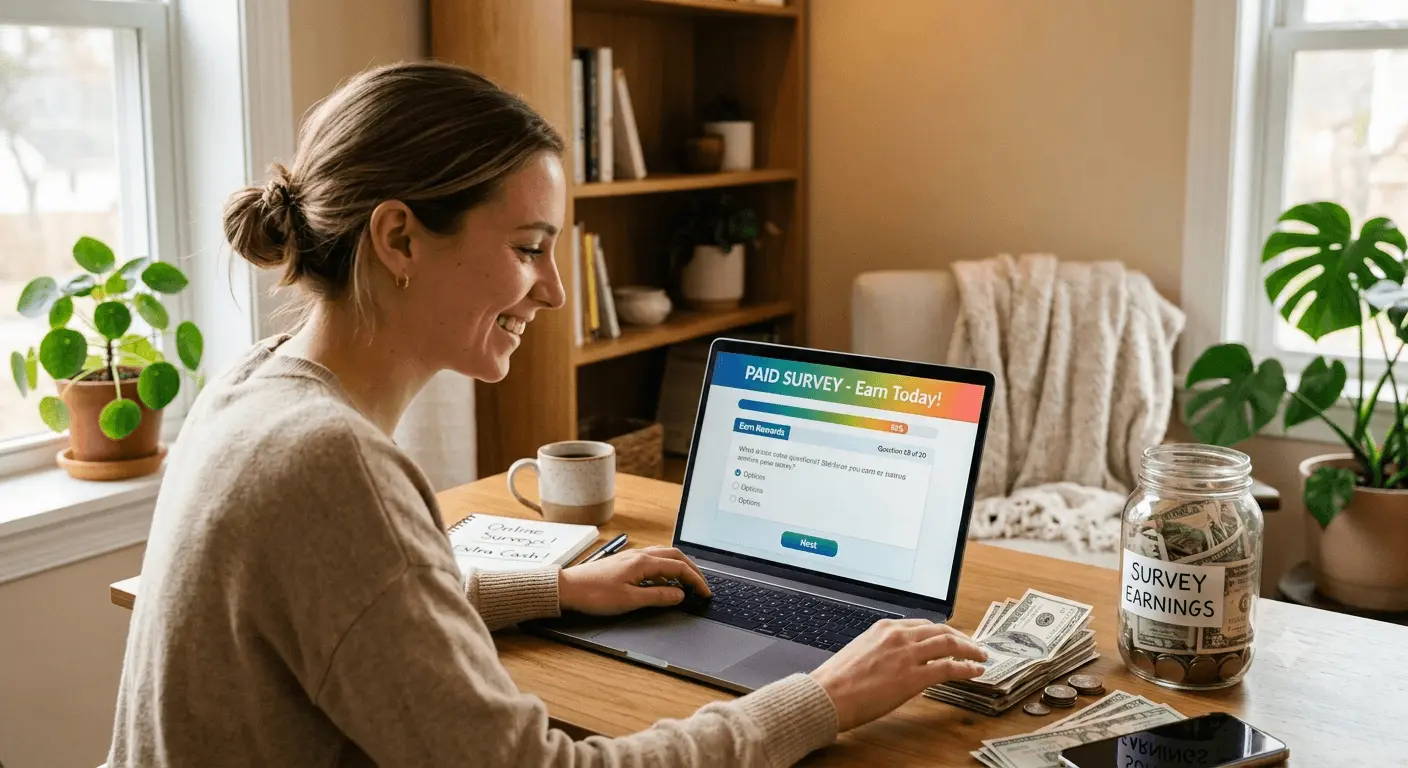
Most articles about survey rewards are written by people who have never completed one. This one isn't. We run a rewards platform that pays people for surveys, offers and games — so we know who actually funds your payout, why you keep getting screened out, and what the money really looks like at the end of the month.
Here's the honest headline: surveys will not make you rich. For someone who does them regularly, the realistic target is pocket money — enough for a few gift cards or a subscription, not a paycheck. If that sounds too small, don't spend your time on it. If it sounds fine, keep reading: below is which surveys are worth your minutes, why gift cards often beat cash, and how to spot a scam before it costs you.
What surveys for gift cards actually pay
These ranges come from the cautious end of what the rewards industry pays — closer to what you will really see than the numbers you'll find in "earn $500 a day" posts. Broken down by how you use it:
- Occasionally (1-2 hours a week): $0.30 - $1 per survey, a realistic $2 - $8 a month.
- Regularly (30-60 minutes a day): $0.50 - $2 per survey, $10 - $30 a month.
- Chasing longer, higher-paying studies: $2 - $5 per survey, $30 - $60 a month.
Two honest notes. Hourly, most surveys land between $0.50 and $2 — this competes with idle time, not with a job. And payouts vary by country, because advertisers budget differently per market. The same survey can pay $2 in the US and a fraction of that elsewhere.
Why gift cards often pay more than cash
This surprises people: on many platforms, the same balance buys a slightly better deal in gift cards than in cash. It isn't a trick. Gift card issuers and retailers want new customers, so they sell reward inventory at a discount or add a bonus. Cash payouts, on the other hand, carry processing fees that come out of the same pot.
Practical takeaway: if you were going to buy an Amazon, Netflix, Google Play, Steam or Spotify gift card anyway, taking your reward in that form is usually the better math. If you need actual money in a bank account, take cash and accept it may be marginally less.
Why you keep getting screened out
The first thing that frustrates every new survey taker: five minutes of questions, then "sorry, you don't qualify." That isn't a bug. Here's the mechanic:
- Quotas. A study needs, say, 500 car owners aged 35-44. When those 500 are in, the survey closes. You were late, not rejected.
- Screening questions. The first questions aren't the survey — they sort you into the right group. If your profile doesn't match, you're out.
- Consistency checks. The same question gets asked twice in different words. Contradict yourself and the system drops you.
The only legitimate way to get screened out less is to fill in your profile completely and truthfully, so the system can route you to studies you actually fit. Guessing what the researcher wants to hear backfires — consistency checks catch it and the reward gets voided.
Who actually pays for your survey?
Knowing this is the fastest scam filter there is. The chain works like this: a brand wants to know who will buy its next product, so it pays a market research company. That company needs real people in specific profiles, so it pays reward platforms. The platform passes part of that payment to you and keeps the rest as commission.
So your reward comes out of an advertising and research budget — which means it has a ceiling. Nobody can pay you more than the value you create for that brand. Any "$300 a week from 15 minutes of surveys" promise breaks that math, and anything that breaks the math is a lie.
Which surveys are worth your time
Four common survey types, with length, reward and whether they're worth starting:
- Short consumer survey (3-8 minutes, $0.30 - $0.80): Yes — ideal for idle time.
- Long profile or habits study (15-25 minutes, $1 - $3): Yes — the best hourly rate.
- Product test or video review (20-40 minutes, $2 - $5): Yes — but rare.
- Low-reward surveys you keep failing (under $0.10): No — skip them.
Judge by reward per minute, not reward alone. A 20-minute survey paying $2 beats a 5-minute one paying $0.30. And don't grind surveys you keep getting screened out of — your time is a real cost.
Can you reach $150-$300 a month?
From surveys alone, realistically no — supply runs out before your time does. The people who reach that band combine surveys with game and app offers, where a single multi-step offer can pay $10-$50 because game studios pay the most for players who genuinely play. Surveys fill the gaps; offers carry the total.
Honest footnote: that band is not a first-month number. It's what a good month looks like after you've learned which offers are worth starting, and it swings with your country and the offers available. But if you're asking where the ceiling is — that's where, and method gets you there, not luck.
How to spot a scam: 5 checks
- If it asks you for money, walk away. Entry fees, "premium membership", payment to unlock a withdrawal — legitimate platforms are paid by advertisers, never by you.
- Minimum payout and processing time must be stated. If you can't find "how much before I can cash out, and how long does it take", leave. Some sites set the threshold deliberately high so you quit before reaching it.
- Look for independent proof of payment. Reviews on independent platforms saying "I got paid" matter; testimonials on the site's own homepage don't.
- Watch what data is requested. Age, occupation and interests are normal. Government ID numbers, bank passwords or card details are not — close the tab.
- The bigger the promise, the bigger the doubt. Remember the economics above: triple-digit monthly promises don't survive them.
Where CashyGo fits
Full transparency: we're writing this, so of course we'll describe our own platform — but held to the same checks above.
- We never ask you for money. Signing up and earning are free; our revenue is the commission advertisers pay.
- $5 minimum withdrawal — among the lowest in the industry, so your first payout arrives in days rather than weeks.
- Payout options: PayPal, crypto (Bitcoin, Ethereum), or gift cards including Amazon, Netflix, Google Play, Steam and Spotify. See the withdrawal page for current options.
- Surveys are only part of it. Game and app offers are where the larger rewards live — browse them on the Earn page.
- And with the same honesty: CashyGo won't make you rich either. Regular use targets the pocket-money band described above.
Other platforms are worth trying too — Swagbucks and similar services have been doing this for years. Most experienced users run two or three platforms at once, because survey supply on any single one is limited.
FAQ
Are paid surveys legit? Yes, platforms that genuinely pay exist — but the scale is small. What's real is getting paid; what's fake is getting rich.
How fast can I get a gift card? With regular use, most people reach a $5 threshold within one to two weeks, and withdrawal requests are usually processed the same day.
Do surveys pay instantly? The reward posts to your balance right after the survey is validated, which is usually immediate but can take a little longer if the researcher reviews responses. Cashing out is a separate step with its own processing time.
Can I earn more with multiple accounts? No. Multiple accounts are banned on every platform and detection voids the earnings. The detection systems are better than people assume — we know, because we run one.
Are survey earnings taxable? At this scale rewards rarely raise an issue, but if you earn regularly and at volume, check the rules where you live.
How this article was made: earning ranges are drawn from publicly available industry averages and deliberately reported from the cautious end so readers aren't misled. The explanations of screening mechanics and reward economics come from first-hand experience operating the CashyGo platform. Last updated: July 2026.