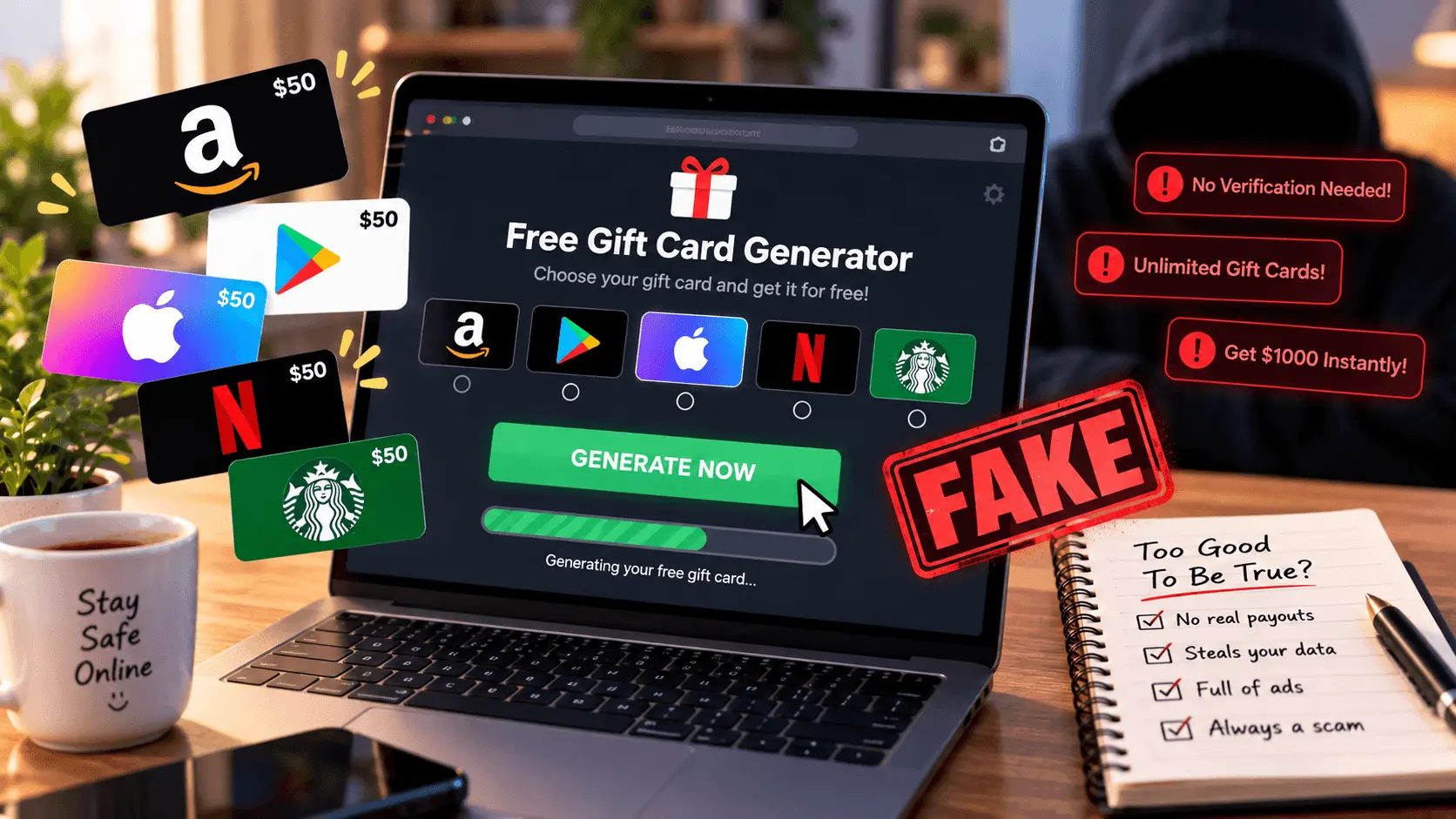
No gift card generator produces a code that redeems. A gift card code is not calculated from a formula. It is a random string that has value only because the issuer recorded it in its own database and switched it on when someone paid for it. A website cannot do either of those things.
How a real gift card code gets its value
Three steps happen on the issuer’s side, and none of them is visible to you.
A generator sits outside all three steps. It can print a string in the right format, with the right number of characters and dashes. It cannot add that string to the issuer’s records.
Why guessing does not work either
Some tools claim to “brute force” codes, meaning they produce so many strings that some must be real. The arithmetic rules this out.
Take a code of 16 characters using letters and digits. That allows 36 to the power of 16 combinations, roughly 8 followed by 24 zeros. Even if an issuer had a billion unused, activated codes outstanding, the chance that one random guess hits one of them would be about 1 in 8 quadrillion.
What the generator page is really for
These pages cost money to build and advertise, so they earn it back from visitors. The usual methods:
The first item is the most common, and it explains the fake progress bar. The animation, the “code found” message with the last characters blurred, and the list of recent winners exist to get you to the verification step. The page owner is paid when you complete it. The code never appears, because there was never one.
What the FTC says about gift cards
The Federal Trade Commission’s guidance on gift card scams is mainly about fraudsters who demand payment by gift card, but two points apply here.
First, the FTC explains why a code is treated like cash: “The card number and PIN on the back of the card let the scammer get the money you loaded onto the card,” even if you still hold the card. A site that asks for the number and PIN of a card you already own, to “double” or “check” its balance, is asking for the money.
Second, on where codes come from, the FTC advises: “Stick to stores you know and trust. Avoid buying from online auction sites because the gift cards may be fake or stolen.” Cut-price codes from unknown sellers carry the same problem as generated ones.
If you lost money, the FTC’s steps are to contact the gift card company right away, ask whether a refund is possible, and report it at ReportFraud.ftc.gov.
The part of the generator pitch that is true
The pitch contains one accurate idea: advertisers do pay when people complete surveys and try apps. The scam page keeps that payment. A rewards platform passes part of it to the person who did the task and buys real gift card codes from the issuer with it. We explain the business model in how get-paid-to sites work.
On CashyGo the route in numbers:
Card amounts differ by brand, so check the amount shown on the withdraw page for the card you want before you plan your points.
CashyGo’s FAQ says there is no guaranteed daily income, and earnings depend on the offers available in your country and the time you put in. Signing up is free, the rules allow one account per person, and users under 18 may need parental consent.
For one brand worked through step by step, see how to get free Amazon gift cards.
How to tell a real reward from a fake one
FAQ
Do any gift card generators work?
No. A valid code has to exist in the issuer’s database and be activated by a sale. A generator can copy the format only.
Are gift card code generators illegal to use?
We do not give legal advice. In practice the tools cannot produce a working code, and the risk falls on you: lost logins, card charges or unwanted software.
I finished the “human verification” and got nothing. Can I get my time or money back?
The time is gone. If you entered card details, contact your card issuer. If you entered a store password, change it now. You can report the site at ReportFraud.ftc.gov.