
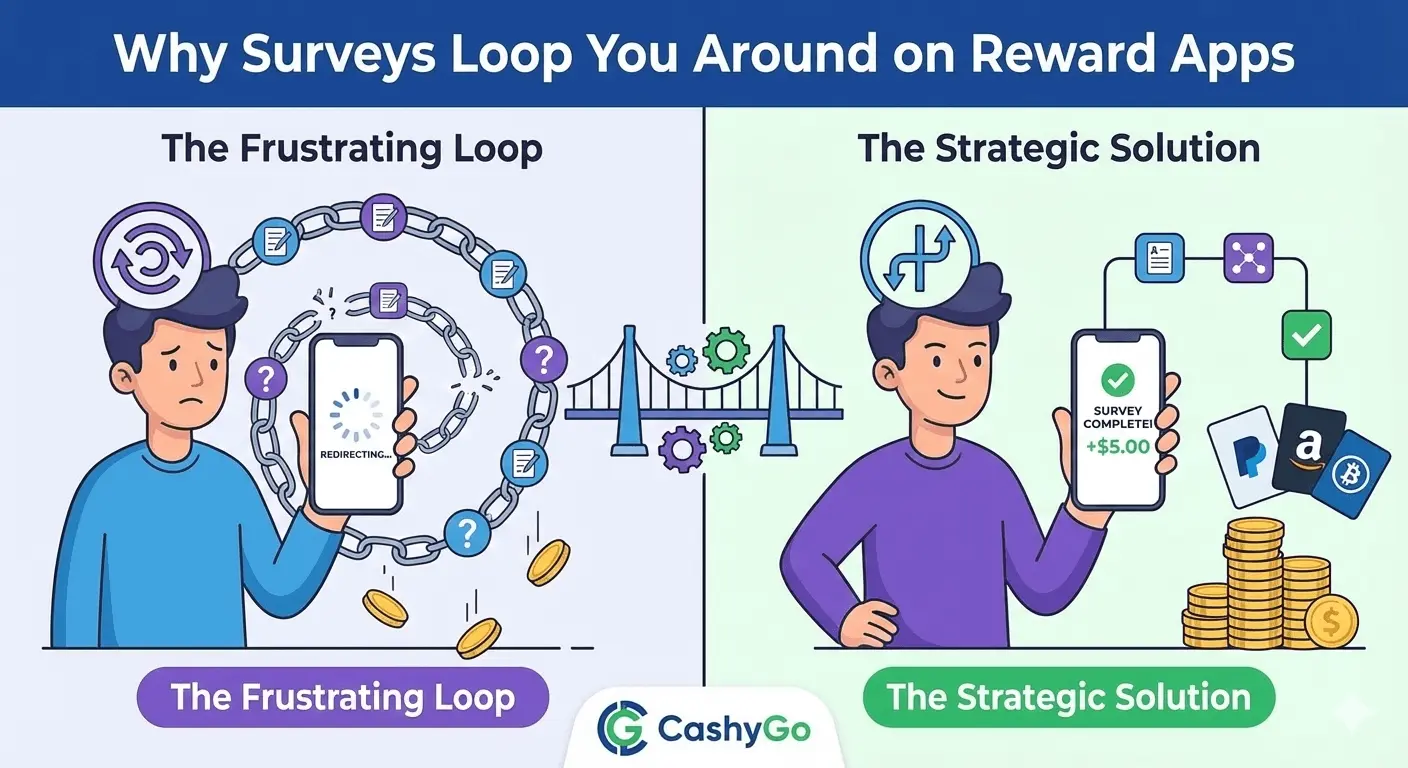
It is the most annoying feeling in the world of online side hustles. You click on a survey that promises $1.50 for 10 minutes. You answer your age, gender, and zip code. Suddenly, the page flashes, the URL bar spins, and you are back at a new screen asking for your age, gender, and zip code again.
You do it again. The screen flashes again. You have entered the "Survey Loop of Death."
After five minutes of this, you haven't earned a cent, and you are ready to throw your phone across the room. Is the site broken? Is it a scam?
Usually, it is neither. It is a technical byproduct of how modern market research works. Understanding why this looping happens is the only way to minimize it and actually start completing tasks on platforms like CashyGo.
What is a "Survey Loop"?
A survey loop occurs when a user is passed from one survey provider to another in rapid succession without successfully landing on a questionnaire. Instead of telling you "You are disqualified," the system tries to be "helpful" by automatically redirecting you to a different opportunity. When this happens five or six times in a row, it feels like a broken record.
1. You Are Dealing with a "Router," Not a Single Survey
When you click a button labeled "Take Survey" on a reward wall, you generally aren't clicking a direct link to a specific questionnaire (like a Google Form). You are entering a Survey Router.
Think of a router like a hotel concierge. You walk up and say, "I want a room." The concierge checks the first hotel; it is full. Instead of kicking you out, they immediately call the next hotel. Then the next.
The "loop" you experience is the router frantically checking dozens of market research companies (Cint, Dynata, Spectrum, etc.) to find one that needs your specific demographic. The flashing screen is the router handing you off to the next provider.
2. The "Quota Full" Bounce
Market researchers need specific groups of people. A car company might need 500 responses from "Males, aged 25–34, who own a Ford."
Once the 500th person submits their answers, that quota is full. If you are the 501st person, you are technically eligible, but they don't need you anymore.
- The Result: You answer the screening questions, the system realizes the bucket is full, and it "bounces" you back to the router. The router then tries to find a different survey, which starts the screening questions all over again.
3. Your Profile Data Doesn't Match
Disqualification loops often happen because of "Shadow Verification."
Let's say your CashyGo profile states you are a 45-year-old female living in New York. You enter a survey router, and the first "screener" question asks for your age. You accidentally click 44.
The system spots the discrepancy immediately. To protect the integrity of the data, it blocks you from that specific survey. However, rather than telling you "You lied," it silently redirects you to a lower-tier survey or loops you back to the start. Consistently accurate data is the only defense against this.
4. The "Orphaned" Link Problem
Reward platforms aggregate thousands of offers. Sometimes, a survey expires or is taken down by the provider, but the link remains active on the offer wall for another hour or two due to caching (stored data).
When you click an orphaned link, the destination server rejects the connection because the project ID no longer exists. A smart router will try to rescue the session by forwarding you to a default "backup" survey, creating that disorienting sense of being sent to the wrong place.
5. Third-Party Cookie Conflicts
Survey tracking relies heavily on browser cookies to ensure you don't take the same survey twice. If your browser blocks third-party cookies, or if you are using an aggressive ad-blocker, the survey platform cannot assign you a unique "Session ID."
Without a Session ID, the router gets confused. It forgets who you are every time the page loads, causing it to present the introductory questions repeatedly. It thinks you are a new visitor every 3 seconds.
6. Trap Questions and Quality Control
Sometimes, the loop is a test. Researchers insert "trap questions" to weed out bots or people clicking randomly.
- Example: "Which of the following is not a fruit? Apple, Banana, Rock, Grape."
- Example: "Please select 'Strongly Disagree' for this question."
If you rush and miss these, the system classifies you as a "low-quality respondent." You won't be banned immediately, but you may be tossed into a "low-priority loop" where you are only shown leftovers that other users rejected.
Practical Checklist: How to Stop the Loop
You cannot eliminate redirects 100%, but you can reduce them significantly. Before your next session, run through this list:
- [ ] Update Your Profile: Ensure your profile on the reward platform matches exactly what you answer in surveys (Zip code, income, pets).
- [ ] Slow Down: Wait 2–3 seconds before clicking "Next" on each question. Speeding triggers bot filters.
- [ ] Disable Ad-Blockers: Turn off AdBlock or uBlock Origin specifically for the survey domain. They often break the redirect scripts.
- [ ] Clear Cache: If a specific provider loops constantly, clear your browser cookies/cache and try again.
- [ ] Stick to Weekdays: Survey inventory is highest on Tuesdays and Wednesdays. Weekends have fewer surveys, meaning routers have to "search harder" (loop more) to find a match.
- [ ] Avoid "Generic" Buttons: Look for surveys that display a specific time and dollar amount (e.g., "10 min / $1.20") rather than a generic "Earn Points" button. The specific ones are usually direct links, not routers.
- [ ] Be Honest: If you don't know an answer, select "None of the above." Trying to qualify for everything triggers inconsistencies.
FAQ: Common User Frustrations
1. Why do I have to enter my Birthday five times?
Because you are likely being rejected by five different survey companies in a row. Each company is a separate entity and cannot legally share your Personal Identifiable Information (PII) with the next one, so you have to re-enter it for every new attempt.
2. Does the platform keep the money if I get disqualified?
No. If you don't complete the survey, the platform (like CashyGo) generally doesn't get paid either. The "loop" is frustrating for the platform too, because it means no revenue is generated for anyone.
3. Is it better to use a phone or a computer?
A laptop or desktop computer is generally better for surveys. Many older survey interfaces are not optimized for mobile screens, which can cause buttons to disappear or pages to reload improperly.
4. Can using a VPN stop the loops?
No, a VPN will make it worse. Survey panels instantly detect VPN/Proxy IPs and will often put you in an endless loop or block you entirely to prevent fraud. Always use your real residential connection.
5. I spent 15 minutes on a survey and then it looped. Why?
This is known as a "late screenout." It is unfair and frustrating, but it happens when a survey has qualification questions at the end (demographic classification). If this happens constantly with a specific provider, stop using that provider's offers.
Survey looping isn't a conspiracy to steal your time; it's a messy technical struggle to match you with a paying client. The router is desperately trying to find a "Yes" in a sea of "No."
By keeping your profile consistent, avoiding weekends when inventory is low, and ignoring the generic routers in favor of specific survey offers, you can spend less time spinning in circles and more time watching your balance grow.